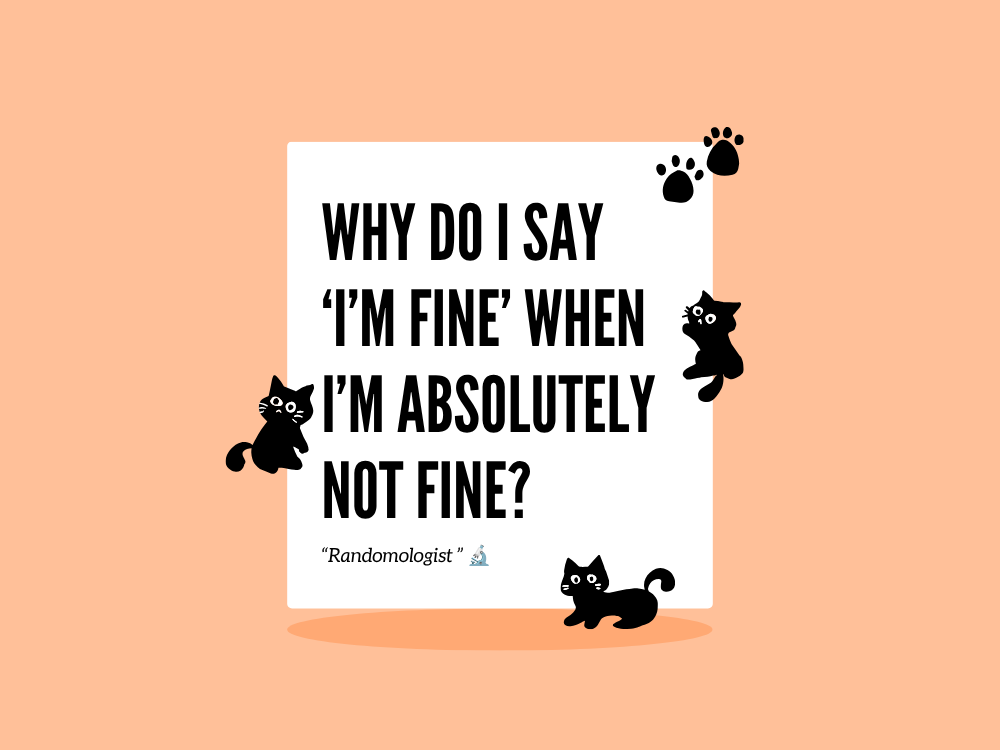
Someone looks at you and asks:
“Are you okay?”
You pause for half a second.
There it is.
The tiny window where you could tell the truth.
You could say:
“Actually, no. I’m having a terrible day.”
You could say:
“I’ve been feeling overwhelmed lately.”
You could say:
“I don’t really know what’s wrong, but I’m not okay.”
Instead, you smile.
Maybe you even laugh.
And say the most automatic sentence in the English language:
“I’m fine.”
And just like that, the conversation moves on.
Problem solved.
Except…
It isn’t.
Because you’re not fine.
You just successfully convinced someone not to ask again.
And sometimes, if we’re being completely honest, you even convince yourself.
“I’m Fine” Is Sometimes a Shield
Most of us don’t say “I’m fine” because we’re trying to lie.
We say it because it’s easier.
It’s quick.
It’s familiar.
It’s safe.
Imagine you’re already overwhelmed and someone asks:
“What’s wrong?”
Now you have to explain.
Where do you even start?
Do you talk about work?
Money?
Your relationship?
Your family?
The thing that happened three months ago that you’re apparently still not over?
The thing you don’t even understand yourself?
Suddenly, answering a simple question feels like opening 47 tabs in your brain.
So you choose the easy option.
“I’m fine.”
And everyone gets to move on.
Sometimes You Don’t Want to Be a Burden
Maybe you’ve learned to handle things yourself.
You’re the reliable one.
The strong one.
The person everyone calls when they need help.
So when you’re struggling, asking for support can feel strange.
You think:
“Other people have problems too.”
“I don’t want to bother anyone.”
“They have enough going on.”
“I’ll figure it out.”
So you carry it quietly.
You help everyone else.
You listen to their problems.
You give advice.
You check on them.
And when someone finally asks how you are?
“I’m fine.”
Because you’ve become so good at taking care of everyone else that you forgot you’re allowed to need care too.
Maybe You’re Afraid of What Happens After You Tell the Truth
Sometimes the scary part isn’t admitting you’re struggling.
It’s what happens afterward.
What if they ask questions?
What if you start crying?
What if you can’t stop?
What if you don’t know how to explain yourself?
What if they think you’re being dramatic?
What if they give you advice you didn’t ask for?
What if they don’t understand?
What if you finally open up and they respond with:
“You’ll be okay.”
And that’s it.
So you learn to keep things to yourself.
Not because you don’t want connection.
Because you don’t want to regret being vulnerable.
“I’m Fine” Can Mean a Hundred Different Things
When someone says:
“I’m fine.”
They might mean:
“I’m okay.”
Or:
“I’m not ready to talk.”
Or:
“I don’t know how to explain what I’m feeling.”
Or:
“Please ask me again later.”
Or:
“I’m trying really hard not to cry.”
Or:
“I want you to notice that I’m not fine without making me say it.”
That’s the tricky part.
We expect people to understand what we don’t say.
But people aren’t mind readers.
Sometimes someone genuinely believes you when you say you’re fine.
They don’t know that your “fine” actually means:
“I’m barely holding it together.”
Sometimes You’re Protecting Other People
Maybe you know that if you tell someone how you’re feeling, they’ll worry.
So you hide it.
You don’t want your parents to worry.
You don’t want your partner to feel responsible.
You don’t want your friends to think something is seriously wrong.
You don’t want to bring down the mood.
So you’re hurting quietly while everyone around you assumes you’re okay.
And here’s the problem:
People can’t support a version of you they don’t know exists.
You don’t have to tell everyone everything.
But the people who genuinely love you deserve the opportunity to show up for you.
You Don’t Have to Explain Everything
Here’s something important:
Being honest doesn’t mean you have to tell your entire life story.
You don’t have to sit down and explain every detail.
You can simply say:
“Honestly, I’m having a rough day.”
That’s enough.
Or:
“I’m not ready to talk about it, but I’m not really okay.”
That’s enough too.
Or:
“I don’t know what’s wrong. I just feel overwhelmed.”
You don’t need a perfectly organized explanation of your emotions before you’re allowed to express them.
Feelings don’t come with bullet points.
Sometimes they’re just messy.
What If You Actually Don’t Know What’s Wrong?
This happens more than people realize.
Someone asks:
“What’s wrong?”
And you’re thinking:
“I genuinely have no idea.”
You just feel off.
Tired.
Irritated.
Sad.
Disconnected.
Overwhelmed.
Unmotivated.
Maybe nothing specific happened.
Maybe it’s ten small things piling up.
You don’t need to know the exact reason before acknowledging how you feel.
You can say:
“I don’t know what’s wrong, but I’m not feeling like myself today.”
That’s honest.
And sometimes saying it out loud is the first step toward figuring it out.
We Get Very Good at Functioning While Struggling
One of the strangest things about emotional pain is that you can still look completely normal.
You go to work.
You answer messages.
You laugh at jokes.
You eat dinner.
You post something online.
You show up to meetings.
You take care of responsibilities.
And everyone assumes:
“They’re doing fine.”
Meanwhile, you’re exhausted from pretending everything is okay.
Being functional doesn’t mean you’re not struggling.
Sometimes it simply means you’ve gotten very good at carrying things quietly.
You Don’t Have to Wait Until You’re Falling Apart
We often think we only deserve support when things become really serious.
“It’s not that bad.”
“Other people have it worse.”
“I’ll deal with it.”
“I’ll be fine eventually.”
But you don’t have to wait until you’re completely overwhelmed before you reach out.
You can talk to someone when you’re simply having a difficult week.
You can ask for help before you’re drowning.
You can say:
“I’m struggling lately.”
That’s enough.
You don’t need to prove that you’re suffering enough to deserve care.
Start With One Person
If you’re used to saying “I’m fine,” suddenly becoming completely open can feel impossible.
So don’t.
Start with one person you trust.
Someone who listens.
Someone who doesn’t immediately judge.
Someone who doesn’t turn every conversation into advice.
You don’t have to tell them everything.
Just let the door open a little.
Try:
“Can I be honest? I’ve actually been having a hard time lately.”
Then see what happens.
Maybe they’ll surprise you.
Maybe they’ll say:
“I’m glad you told me.”
And maybe, for the first time in a while, you won’t have to carry everything alone.
And Yes, Sometimes You Really Are Fine
Let’s not overcomplicate it.
Sometimes someone asks if you’re okay and you genuinely are.
Then say:
“I’m fine.”
There’s nothing wrong with that.
The problem isn’t the phrase.
The problem is when “I’m fine” becomes your automatic response to everything.
When you’re happy.
When you’re sad.
When you’re overwhelmed.
When you’re angry.
When you’re lonely.
When you’re falling apart.
If every emotion gets the same answer, eventually you stop listening to yourself.
Try Checking In With Yourself
Before answering someone else, sometimes check in with yourself.
Ask:
How am I actually feeling?
Not:
“How should I be feeling?”
Not:
“Is this serious enough to matter?”
Just:
“What am I feeling right now?”
Maybe you’re tired.
Maybe you’re lonely.
Maybe you’re frustrated.
Maybe you’re scared.
Maybe you’re disappointed.
Maybe you’re okay.
Whatever the answer is, let it be the answer.
You don’t have to argue with your own emotions.
You Can Be Strong and Still Say You’re Not Okay
This might be the biggest misconception.
We think strong people handle everything themselves.
They don’t complain.
They don’t cry.
They don’t need help.
They keep going.
But real strength isn’t pretending nothing affects you.
Real strength can look like:
“I’m struggling.”
“I need help.”
“I don’t know what to do.”
“That hurt me.”
“I need someone to listen.”
Those aren’t signs of weakness.
They’re signs that you’re honest enough to acknowledge reality.
You don’t become weaker by admitting you’re struggling.
Sometimes you become stronger because you finally stop wasting energy pretending you’re not.
You Don’t Have to Be the Strong One All the Time
Maybe you’re the person everyone relies on.
The friend who always answers.
The sibling who helps.
The partner who stays calm.
The person who says:
“Don’t worry. I’ll handle it.”
But who handles it when you need someone?
You are allowed to put the superhero costume down sometimes.
You are allowed to be the one who needs reassurance.
You are allowed to have a bad day.
You are allowed to say:
“I don’t have it together today.”
The world won’t collapse.
And the people who love you won’t suddenly think less of you.
In fact, letting people see the real you may give them a chance to love you more deeply.
The Lesson
Maybe you’ve been saying “I’m fine” because you don’t want to be difficult.
Maybe you’re afraid of being judged.
Maybe you’re afraid of crying.
Maybe you don’t want to burden anyone.
Maybe you don’t even know how to explain what you’re feeling.
Whatever the reason, you don’t have to force yourself to become completely vulnerable overnight.
Just start being a little more honest.
Instead of:
“I’m fine.”
Try:
“I’m having a rough day.”
Instead of:
“Nothing’s wrong.”
Try:
“Something’s bothering me, but I don’t know how to talk about it yet.”
Instead of:
“I’ll handle it.”
Try:
“Could you stay with me for a bit?”
Sometimes that’s all it takes.
Not a dramatic confession.
Not a perfect explanation.
Just one honest sentence.
Because you deserve relationships where you don’t always have to say you’re fine.
You deserve people who can handle the truth.
And most importantly, you deserve to be honest with yourself.
So the next time someone asks:
“Are you okay?”
Pause before you automatically answer.
Check in with yourself.
And if you’re not fine?
You don’t have to pretend.
You can simply say:
“Honestly… not really.”
And maybe that’s where things finally start getting better.