
For years, one question has followed Apple everywhere:
When will the iPhone finally fold?
The rumors came and went. Concept designs imagined impossible-looking screens. Competitors moved ahead with their own experiments, while Apple remained unusually quiet.
That silence is over.
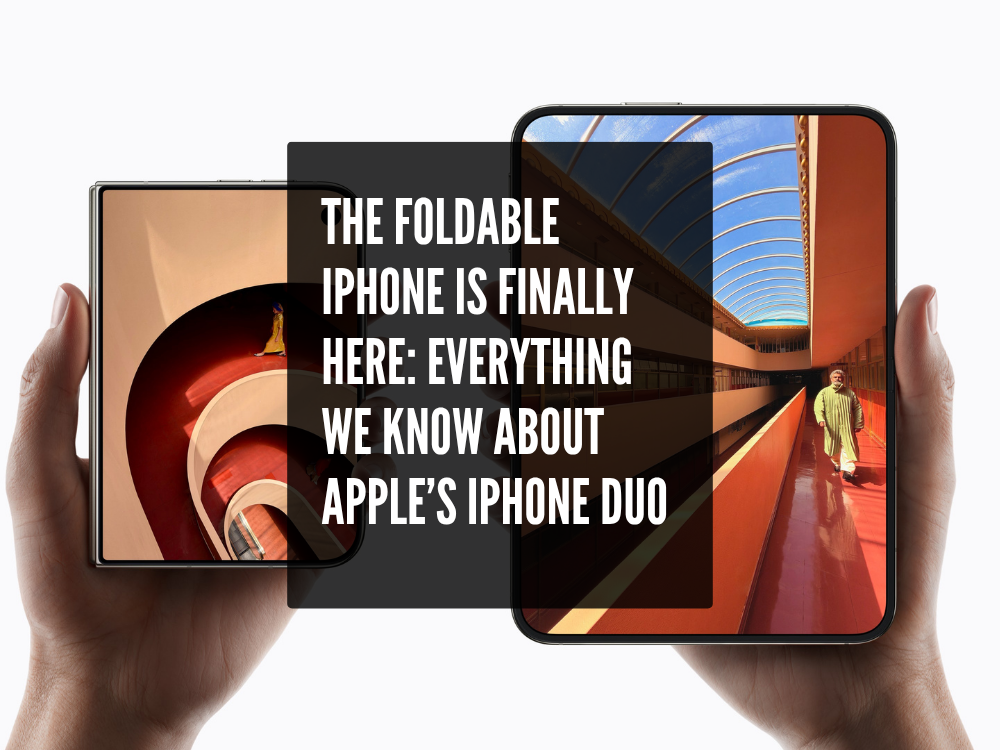
Apple has officially unveiled its first folding iPhone, the iPhone Duo, marking one of the most significant changes to the company’s smartphone design in years. Rather than simply making another model with a better camera or faster processor, Apple has changed something far more fundamental: the shape of the device itself.
Closed, the Duo works like a compact smartphone. Open it, and the experience expands into a 7.6-inch display, giving users considerably more room for entertainment, productivity, gaming and multitasking. A 5.4-inch outer display handles everyday tasks when the phone is shut.
It’s a simple idea, but seeing Apple finally put it into a finished product makes it feel surprisingly new.
And now that the long wait is over, there’s a lot to talk about.
A Different Kind of iPhone
The familiar iPhone silhouette has remained largely unchanged for years. Each generation has brought refinements, but the basic formula has been remarkably consistent: a slim rectangle that lives in your hand and pocket.
The Duo breaks that pattern.
Open the device and the compact handset becomes something much closer to a miniature tablet. Close it again and it returns to a more traditional size.
That flexibility is the main attraction.
You could use the smaller display to check messages, answer a call or quickly look something up. When you need more space, opening the device gives you a much larger canvas without requiring a second gadget.
It sounds straightforward.
But that change could have a surprisingly big impact on how people use their phones.
Why Did Apple Wait So Long?
Apple isn’t entering unexplored territory.
Samsung and other manufacturers have already spent years developing devices with hinges and flexible displays. Some models have become impressively thin, while others have pushed the category toward larger, more sophisticated designs.
So Apple’s timing is worth considering.
The company had the advantage of watching the industry learn from its mistakes.
Early folding phones raised concerns about durability, thickness, battery life, software and the visible crease running through the middle of the display. Those issues haven’t disappeared entirely, but the technology has matured considerably.
Apple now enters the market with years of experience from other manufacturers to study.
That doesn’t guarantee success, but it does give the company a very different starting point from the pioneers who had to figure everything out themselves.
The Price Will Get People Talking
There is one detail that is impossible to ignore:
The iPhone Duo starts at $1,999 in the United States.
Higher-storage versions can push the price considerably further, reaching $3,199 at the top end.
That’s a serious investment for any smartphone.
At this level, customers aren’t simply deciding whether they want a new iPhone. They’re deciding whether the advantages of a large, flexible display justify spending substantially more than they would on a conventional flagship.
For technology enthusiasts, that premium may be part of the appeal.
For everyone else, it could be the biggest reason to wait.
And that makes the Duo particularly interesting: Apple has created a product that many people will want to try, but far fewer may be ready to buy.
More Room to Actually Do Things
A larger display only matters if you can make good use of it.
Apple has designed the software experience around the expanded workspace, allowing users to take advantage of multiple apps and windows rather than simply displaying an oversized version of a normal phone interface.
Think about checking an email while referring to a document.
Watching a video while browsing.
Taking notes during a video call.
Comparing information from two websites.
These are tasks that can feel cramped on a conventional handset.
With the Duo opened, there’s considerably more breathing room.
That may ultimately be its strongest argument.
The novelty of watching the phone transform will eventually wear off. The usefulness of having extra space won’t.
It Could Blur the Line With the iPad
This is where things get particularly interesting for Apple’s ecosystem.
The Duo isn’t just larger when opened. It also supports Apple Pencil, bringing a feature traditionally associated with the iPad to a device that can still fit into your pocket when closed.
That opens up possibilities for sketching, handwriting, signing documents, annotating files and taking notes.
It also raises a question Apple probably doesn’t mind people asking:
How much tablet do you really need?
For someone who already owns an iPad, the answer may be “quite a lot.”
But for a customer who has always wanted a bigger workspace without carrying another device, the Duo could be an appealing compromise.
One device can serve two purposes.
That’s the larger vision behind the product.
Apple Also Changed How You Unlock It
Another surprising decision is hiding in plain sight.
Instead of Face ID, the Duo uses Touch ID built into the side button. The inner camera is placed beneath the display, helping preserve the uninterrupted appearance of the larger panel.
For longtime iPhone owners, that’s a notable departure.
Apple spent years moving users toward facial authentication, so seeing a fingerprint sensor return on such a premium model is unexpected.
But the unusual body creates unusual engineering constraints.
Sometimes designing something new means abandoning familiar solutions.
The Duo is full of those compromises—and that’s part of what makes it interesting.
The Cameras Take Advantage of the Design
Photography remains a major part of the iPhone experience.
The Duo features a dual 48-megapixel rear-camera system, but the more interesting story is how the two displays can work alongside the cameras.
The outer panel can act as a preview for people being photographed or filmed.
That could be particularly useful for content creators.
Imagine setting the phone up to record yourself and being able to see your framing from the opposite side. Instead of relying entirely on the front-facing camera, you can potentially use the more capable rear cameras while still monitoring what is happening.
It’s a small example of something bigger:
The hinge isn’t just a physical feature. It creates new ways for the hardware to interact with itself.
What About Durability?
This may be the question that matters most after the price.
People are used to phones that don’t move.
The Duo has a hinge, a flexible display and a mechanism that will be opened and closed repeatedly.
Apple says it has built the device with a titanium frame reinforced with ceramic fibers, Ceramic Shield protection and an IP68 rating for water and dust resistance.
Those specifications sound reassuring.
But real-world durability is something only time can prove.
A phone can survive Apple’s testing and still face very different conditions in the hands of millions of users.
Some owners will treat it carefully.
Others will drop it, stuff it into crowded pockets, open and close it hundreds of times, and take it everywhere from beaches to construction sites.
That’s when we’ll find out whether Apple has genuinely solved the durability concerns associated with this category.
Battery Life Has Its Own Challenge
The larger display creates another problem: power consumption.
More pixels require more energy, while the hinge and other components take up valuable internal space that could otherwise be used for a larger battery.
Apple says the Duo uses a dual-cell battery system and can provide up to 24 hours of regular use, with additional claims for video playback and fast charging.
Those numbers will be worth testing once independent reviewers get their hands on the device.
Because a beautifully engineered smartphone isn’t much fun if you’re searching for a charger before the day is over.
Thinness Matters More Than It Sounds
One of the first things people notice about a folding phone is its thickness.
When closed, you’re essentially stacking two halves of a smartphone together.
Apple has tried to minimize that problem.
The Duo measures approximately 5.2mm when unfolded and around 11.3mm when closed, according to reports following the launch.
That’s remarkably thin when you consider what has to fit inside.
Still, Apple isn’t necessarily the absolute leader in thickness. Some competitors have produced even slimmer folding devices.
But numbers alone don’t tell the whole story.
What matters is whether the phone feels comfortable in everyday use—and whether Apple has managed to balance thinness with strength, battery capacity and thermal performance.
Who Is Actually Going to Buy This?
The Duo isn’t designed for someone who simply wants the cheapest way into the Apple ecosystem.
At $1,999, the target audience is fairly obvious.
It’s for people who love technology and don’t mind paying a premium for something new.
It’s for frequent travelers who want more display space without carrying a tablet.
It’s for professionals who do a lot of work from their phone.
It’s for creators who can take advantage of the unusual camera setup.
And, of course, it’s for people who simply want the most unconventional iPhone available.
There’s nothing wrong with that last reason.
Sometimes people buy technology because it excites them.
And the Duo certainly has that quality.
Is It Worth $1,999?
That’s where things get complicated.
If all you need is a phone for messaging, social media, photography and calls, probably not.
A conventional iPhone can already handle those things extremely well.
The Duo makes its case by offering something different.
You aren’t paying $1,999 simply for better performance.
You’re paying for versatility.
You’re paying for a device that changes depending on how you use it.
You’re paying for a larger workspace that disappears into a smaller form when you don’t need it.
Whether that is enough to justify the price will be different for every buyer.
The Bigger Question: Does Apple Change the Foldable Market?
This may be more important than the Duo’s individual sales.
Apple has an enormous global audience.
Millions of people who never considered buying a folding phone may now walk into an Apple Store and try one.
Some will love it.
Some will laugh at the price.
Some will decide their regular iPhone is perfectly fine.
But even curiosity can help grow an entire category.
Foldables currently represent only a small portion of worldwide smartphone sales, according to industry figures cited by AP. Apple’s arrival could give the category a significant boost.
That’s why competitors will be watching closely.
If the Duo succeeds, other manufacturers will have even more reason to invest in the technology.
If it struggles, Apple may have a much harder time convincing consumers that this is the next major step in smartphones.
When Can You Get It?
Apple says the iPhone Duo will be available for preorder beginning October 16, 2026, with general availability starting October 23.
That gives potential buyers a few weeks to decide whether they’re ready to make the leap.
And by the time the first units reach customers, we’ll start getting answers to questions that no launch event can completely settle.
How comfortable is it?
How noticeable is the crease?
How good is the battery?
Does multitasking actually make everyday life easier?
How does it hold up after months of use?
And perhaps the biggest question of all:
Will people still love it after the novelty wears off?
The Start of a New iPhone Era?
The iPhone Duo is fascinating because Apple isn’t simply adding another feature to a familiar product.
It’s experimenting with the fundamental idea of what an iPhone should be.
For nearly two decades, the formula has been remarkably consistent.
You pick up the phone.
You look at the screen.
You use it.
The Duo introduces another step:
Open it.
That one movement changes the amount of space available, the way apps can be arranged, the kind of work you can do and even how you interact with the device.
It sounds like a small mechanical trick.
It could turn out to be something much bigger.
Apple has finally stepped into a category that competitors have been building for years. Now the company has to prove that its approach can make folding technology feel less like a novelty and more like the natural next chapter of the smartphone.
The price is high.
The technology is ambitious.
The expectations are enormous.
But perhaps that’s exactly why people are going to be watching.
Because after years of asking when, we finally have an answer.
The iPhone folds.
Now we get to find out whether people actually want it that way.
The wait is over. The experiment has begun. And the next chapter of the iPhone may look very different from the one we’ve known.