Why did they reply with a period?
Why did they take three hours to respond?
Why did I say that thing at dinner?
Did I sound stupid?
Did they notice?
Why did my boss say, “Can we talk tomorrow?”
AM I GETTING FIRED?
Why did my friend say “okay” instead of “okayyy”?
Are they mad at me?
Should I have said something different?
What if I made the wrong decision?
What if I make the wrong decision tomorrow?
What if I choose the wrong thing and accidentally ruin my entire life?
Congratulations.
You’ve entered the wonderful world of overthinking, where a five-second interaction can become a 47-minute investigation and your brain apparently has unlimited battery life.
And the most annoying part?
You know you’re doing it.
You tell yourself:
“Stop thinking about it.”
Your brain:
“Absolutely. Anyway, here’s another possible scenario.”
Your Brain Is Trying to Protect You
Let’s start with something important.
You’re not overthinking because you’re stupid.
You’re not weak.
You’re not dramatic.
And you’re definitely not the only person who can turn a simple decision into a full committee meeting.
Overthinking often comes from your brain trying to protect you.
Your brain wants certainty.
It wants to know:
What happens next?
Will I be okay?
Did I make the right choice?
Do they still like me?
Am I making a mistake?
The problem is that life doesn’t give us many guarantees.
So your brain tries to create certainty by thinking harder.
And harder.
And harder.
Until you’ve spent two hours analyzing something that took another person approximately six seconds to forget.
Sometimes You Think You’re Solving a Problem
Here’s the sneaky thing about overthinking.
It feels productive.
You’re sitting there thinking:
“I’m just trying to understand the situation.”
“I’m figuring out what I should do.”
“I’m considering all the possibilities.”
Sounds responsible.
But there’s a difference between thinking and ruminating.
Thinking helps you move toward a decision.
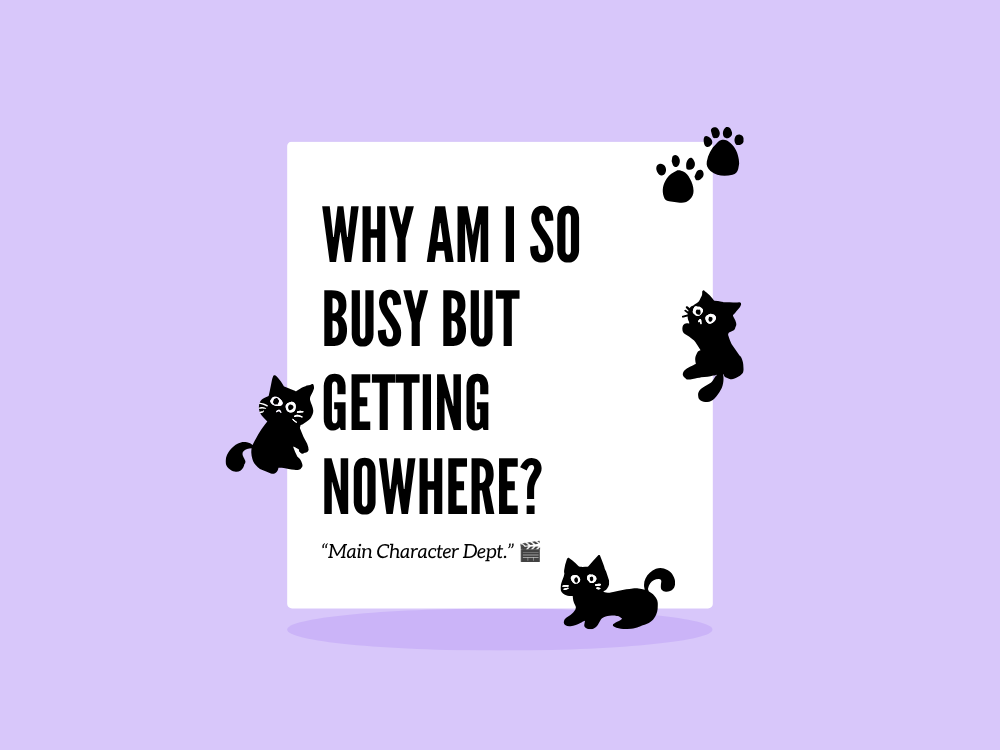
Overthinking keeps you circling the same question without actually moving.
It’s like walking on a treadmill and wondering why you haven’t arrived anywhere.
You’re exhausted.
But you’re still in the same place.
“What If?” Is Overthinking’s Favorite Phrase
Overthinking loves two words:
What if?
What if they don’t like me?
What if I fail?
What if I embarrass myself?
What if I regret this?
What if something goes wrong?
What if I choose the wrong career?
What if I end up alone?
What if everything falls apart?
And here’s the problem.
There is no finish line for “what if.”
You answer one question and your brain immediately creates another.
What if this happens?
Okay.
Then what if that happens?
And if that happens?
And if that happens?
At some point you’re planning for a disaster that hasn’t happened, probably won’t happen, and may not even be possible.
Meanwhile, the actual present moment is sitting quietly in the corner wondering why you’re ignoring it.
Sometimes You’re Trying to Avoid Making a Decision
Overthinking can also be procrastination wearing glasses.
You keep researching.
You ask everyone’s opinion.
You make lists.
You compare options.
You think about it tomorrow.
Then next week.
Then next month.
Because as long as you’re still thinking, you don’t have to choose.
And if you don’t choose, you can’t choose wrong.
At least that’s what your brain tells you.
But not choosing is still a choice.
Sometimes the desire to make the perfect decision prevents you from making a perfectly reasonable one.
There Is No Perfect Decision
This is one of the hardest lessons to accept.
You can make the best decision you can with the information you currently have…
and still have things go wrong.
That’s life.
You could choose the “right” career and later change your mind.
Choose the right relationship and still have disagreements.
Move somewhere amazing and eventually miss home.
Start a business and discover you hate running a business.
Take an opportunity and realize it wasn’t for you.
That doesn’t necessarily mean the decision was wrong.
It means you learned something you couldn’t have known beforehand.
Sometimes you don’t need the perfect answer.
You need an answer that’s good enough to move forward.
Overthinking Gets Worse When You Don’t Trust Yourself
Maybe deep down, the real problem isn’t that you think too much.
Maybe it’s that you don’t trust yourself to handle what happens next.
You think:
“If I make the wrong choice, I’ll regret it forever.”
“If they reject me, I won’t know what to do.”
“If this doesn’t work, I’ll be screwed.”
But what if you changed the question?
Instead of:
“What if I make the wrong decision?”
ask:
“If this doesn’t work out, can I handle it?”
Usually, the answer is yes.
You’ve handled difficult things before.
You’ve survived awkward moments.
You’ve recovered from bad decisions.
You’ve figured things out.
You don’t need to predict every problem.
You need to trust that you’ll be able to respond when problems actually happen.
Not Every Thought Deserves a Court Hearing
This is a big one.
Your brain produces thoughts constantly.
That doesn’t mean every thought is true.
You think:
“They probably hate me.”
That’s a thought.
Not a fact.
You think:
“I’m going to fail.”
That’s a thought.
Not a prediction from the universe.
You think:
“Everyone else is doing better than me.”
That’s a thought.
Not a measurable scientific conclusion.
Your brain can be incredibly convincing.
It can also be completely wrong.
So instead of asking:
“Is this thought true?”
sometimes ask:
“Is there actual evidence for this?”
That’s a much better question.
The Text Message Investigation
Let’s talk about texting.
Because overthinking a text message deserves its own Olympic event.
They write:
“Sure.”
You think:
“Why did they say sure?”
Maybe they’re angry.
Maybe they’re annoyed.
Maybe they’re losing interest.
Maybe you said something wrong.
Maybe they don’t care anymore.
Meanwhile, they were probably holding groceries in one hand and typing with the other.
Not every short message has a hidden meaning.
Sometimes:
“Sure” means sure.
Wild concept.
We can save ourselves so much stress by not assigning a psychological profile to every punctuation mark.
Sometimes You Need to Stop Asking Everyone
When you’re uncertain, it’s tempting to ask five different people:
“What would you do?”
And then you get five different answers.
Now you’re more confused.
So you ask three more people.
Now you have eight opinions.
Excellent.
You have successfully transformed one decision into a group project.
Advice can be helpful.
But eventually, you have to listen to yourself.
Because other people aren’t living your life.
They don’t have your exact priorities.
They don’t have your history.
They don’t have to live with the consequences.
You can gather advice without outsourcing your decisions.
Try Giving Yourself a Deadline
If you tend to overthink decisions, try creating a decision window.
For example:
“I’ll think about this tonight and decide tomorrow.”
Then stop.
You don’t need another 14 hours of analysis.
For smaller decisions, give yourself five minutes.
For bigger ones, give yourself a few days.
The goal isn’t to rush.
It’s to prevent endless thinking from pretending to be preparation.
At some point:
Research becomes avoidance.
You have enough information.
Now you need to act.
Separate What You Can Control
This can change everything.
Take a situation you’re overthinking and divide it into two categories:
What I can control
Your actions.
Your communication.
Your effort.
Your boundaries.
Your decisions.
Your response.
What I can’t control
Someone else’s feelings.
Someone else’s behavior.
The future.
Other people’s opinions.
Whether everything goes according to plan.
Once you separate those things, you have somewhere to put your energy.
Focus on your side.
Let the rest exist without trying to mentally wrestle it into submission.
Don’t Try to Solve Tomorrow Today
One of the biggest causes of anxiety is trying to live future problems before they happen.
You’re sitting on your couch worrying about something that might happen next month.
And you’re emotionally experiencing it today.
Why?
You don’t have to attend tomorrow’s problems today.
If something actually happens, you’ll deal with it then.
Until then, you’re allowed to live.
Eat your dinner.
Watch your show.
Go outside.
Talk to your friend.
Enjoy the moment.
The future doesn’t need to be solved tonight.
Your Brain Needs a Break Too
Sometimes overthinking gets worse when you’re physically exhausted.
You’re tired.
You’ve had a long day.
Your brain is overstimulated.
You scroll for hours.
You drink too much caffeine.
You don’t sleep enough.
Then at 1:37 a.m., your brain decides:
“Now would be an excellent time to reconsider every decision you’ve made since 2014.”
No.
Go to bed.
Seriously.
Some problems look significantly less terrifying after sleep.
Not every late-night realization is a breakthrough.
Sometimes you’re just tired.
Write It Down
If your thoughts are running in circles, get them out of your head.
Write:
What am I worried about?
Then:
What do I actually know?
Then:
What am I assuming?
Then:
What can I do about it?
And finally:
What can I let go of?
This turns a giant emotional cloud into something you can actually see.
You might realize that half of your anxiety is based on assumptions.
And assumptions are much easier to challenge when they’re written on paper.
Practice Saying: “I Don’t Know Yet”
Overthinkers often hate uncertainty.
We want answers immediately.
But sometimes the healthiest answer is:
“I don’t know yet.”
You don’t know how the interview will go.
You don’t know whether the relationship will work.
You don’t know where you’ll be in five years.
You don’t know whether the decision will be perfect.
And that’s okay.
You don’t need certainty to move forward.
You need enough information to take the next reasonable step.
Stop Punishing Yourself for Past Decisions
Another reason we overthink is because we’re constantly trying to prevent future mistakes by analyzing old ones.
“I should’ve known.”
“Why did I do that?”
“How could I have been so stupid?”
Maybe you made a bad decision.
Learn from it.
But don’t turn learning into self-punishment.
You made that decision with the knowledge, experience, and emotional state you had at the time.
Now you know more.
That’s growth.
You don’t need to keep reopening the case.
The verdict has already been delivered.
You learned.
Move on.
The Goal Isn’t to Never Overthink Again
Let’s be realistic.
You’re probably going to overthink sometimes.
Everyone does.
The goal isn’t to become a person who never worries.
It’s to become someone who notices when their brain is spiraling and knows how to step out of it.
You can say:
“Okay, I’m doing it again.”
Then breathe.
Look at the facts.
Ask what you can control.
Make the decision.
Take the next step.
And get back to your life.
You don’t have to believe every thought that enters your head.
The Lesson
Maybe you overthink everything because you’re trying to protect yourself from uncertainty.
You think if you analyze enough, you’ll prevent pain.
If you plan enough, you’ll prevent mistakes.
If you worry enough, you’ll somehow guarantee that everything turns out okay.
But that’s not how life works.
You can’t think your way into certainty.
You can’t predict every outcome.
You can’t control everyone.
And you definitely can’t guarantee that you’ll never make a mistake.
What you can do is trust yourself a little more.
Trust that you can make a reasonable decision.
Trust that you can change your mind.
Trust that you can apologize if necessary.
Trust that you can learn.
Trust that you can survive disappointment.
Trust that you can handle whatever comes next.
Because maybe the real solution to overthinking isn’t finding the perfect answer.
Maybe it’s realizing:
“Even if things don’t go exactly how I want, I’ll figure it out.”
So the next time your brain starts turning one tiny problem into a full-blown Netflix series, pause.
Ask yourself:
Is there actually something I need to do right now?
If yes, do it.
If no, let the thought go.
You don’t have to solve every possibility.
You don’t have to understand everything.
You don’t have to know exactly what happens next.
Sometimes you just need to take a breath, make the best decision you can, and keep living.
Because your life is happening right now.
Don’t spend the entire thing thinking about it.