You know what you want.
At least, you think you do.
You want more money.
Better health.
A better relationship.
More confidence.
Less stress.
A career you actually enjoy.
A cleaner home.
Better habits.
More peace.
Maybe you even have an entire Pinterest board dedicated to the person you’re supposed to become.
And yet…
You wake up and do the same things.
Scroll too much.
Spend money you said you’d save.
Stay up too late.
Avoid the thing you’ve been putting off.
Text the person you promised yourself you’d stop texting.
Say yes when you wanted to say no.
Complain about the same problem.
Then tomorrow comes.
And you do it again.
At some point, you have to ask:
“If I want better so badly, why do I keep choosing the same things?”
Well…
Because wanting something and being ready to change your behavior are two completely different things.
And unfortunately, your life responds much more to what you do repeatedly than what you say you want.
Wanting Better Is Easy
Let’s be honest.
Wanting a better life feels amazing.
You can imagine it without doing any of the uncomfortable work.
You picture yourself:
Financially stable.
Healthy.
Confident.
Successful.
Organized.
Peaceful.
Successful enough that people who doubted you suddenly become very interested in your life.
You imagine the transformation.
The new version of you looks fantastic.
But then your alarm goes off.
And suddenly Future You is nowhere to be found.
Present You is negotiating with the snooze button like it’s a hostage situation.
“Just ten more minutes.”
And there goes the morning routine.
Again.
Your Brain Loves Familiar
This is one reason change is so difficult.
Even when your current habits aren’t good for you, they’re familiar.
Your brain knows them.
You know what happens when you scroll for an hour.
You know what happens when you order food instead of cooking.
You know what happens when you avoid the difficult conversation.
You know what happens when you spend money impulsively.
You know what happens when you procrastinate.
It’s predictable.
And predictable feels safe.
Change?
Change is uncertain.
You don’t know whether you’ll succeed.
You don’t know whether you’ll enjoy the new routine.
You don’t know whether people will react differently.
You don’t know whether all that effort will actually pay off.
So your brain whispers:
“Why don’t we just do what we always do?”
And because you’re tired, you agree.
Sometimes Your Bad Habits Are Doing a Job
This is important.
Don’t just ask:
“Why am I doing this?”
Ask:
“What is this behavior giving me?”
Maybe scrolling gives you escape.
Maybe spending gives you excitement.
Maybe staying in bed gives you relief.
Maybe procrastinating protects you from the possibility of failing.
Maybe staying in an unhealthy relationship protects you from loneliness.
Maybe saying yes to everyone protects you from rejection.
Bad habits often have a benefit.
They’re just benefits with terrible long-term consequences.
If you only try to remove the behavior without replacing what it provides, your brain will eventually drag you back.
You Say You Want Discipline, But Maybe You Need Less Friction
Let’s say you want to exercise every morning.
You set the alarm.
Your workout clothes are buried somewhere under seven shirts.
Your shoes are in another room.
You haven’t planned the workout.
Your phone is next to your bed.
And your brain wakes up thinking:
“Absolutely not.”
So you don’t exercise.
Then you call yourself lazy.
But maybe you weren’t lazy.
Maybe you made the good choice unnecessarily difficult.
Put your clothes out the night before.
Keep your shoes ready.
Choose the workout beforehand.
Make the first step ridiculously easy.
The easier the behavior is to start, the less you’ll have to negotiate with yourself.
Stop Relying on Your Mood
If you only do what you need to do when you feel like doing it, you’re going to have a very interesting life.
Some days you’ll feel motivated.
Some days you’ll feel unstoppable.
Other days you’ll feel like a potato with Wi-Fi.
That’s normal.
You can’t build your future entirely around your mood.
Sometimes you have to say:
“I don’t feel like doing this. I’m doing it anyway.”
Not everything requires motivation.
Sometimes it requires a decision.
But Don’t Turn Discipline Into Self-Punishment
There’s another trap.
You decide:
“That’s it. I’m changing everything.”
Suddenly you’re waking up at 5 a.m., exercising seven days a week, eating perfectly, reading 50 pages a night, working on three side hustles, drinking green juice, meditating, journaling, and somehow becoming fluent in Spanish by Thursday.
By the weekend, you’re exhausted.
Then you quit everything.
Again.
The problem wasn’t that you couldn’t change.
You tried to change your entire identity overnight.
Start smaller.
Much smaller.
Make the Goal Almost Embarrassingly Easy
Want to read more?
Read five pages.
Want to exercise?
Walk for ten minutes.
Want to save money?
Start with a small automatic transfer.
Want to write?
Write 200 words.
Want to clean?
Do one surface.
Want to spend less time online?
Delete one distracting app.
The goal isn’t to impress yourself.
The goal is to create consistency.
Because five minutes done repeatedly can become a habit.
And a habit can become a lifestyle.
You Need to Stop Negotiating With Yourself
This is where things get spicy.
You’ve probably had this conversation:
“I’ll start tomorrow.”
Tomorrow:
“Okay, but today was unusually stressful.”
Next day:
“I’ll start Monday.”
Monday:
“This week is already chaotic.”
Next Monday:
“Maybe next month.”
And suddenly it’s six months later.
At some point, you have to stop holding meetings with the version of yourself who keeps making excuses.
Decide.
Then follow through.
Not perfectly.
Just consistently enough to create evidence that you’re serious.
Your Environment Is Probably Stronger Than Your Willpower
If you keep junk food in the house, you’re going to think about eating it.
If your phone is next to your bed, you’re probably going to check it.
If shopping apps are one tap away, spending becomes easy.
If your workspace is chaotic, starting work becomes harder.
Don’t make every good decision a battle.
Change the environment.
Make bad habits inconvenient.
Make good habits convenient.
Put the book on your pillow.
Keep water beside your desk.
Move distracting apps.
Prepare meals.
Automate savings.
Put your gym clothes where you can see them.
Make your environment quietly push you toward the person you’re trying to become.
You Might Be Addicted to the Idea of Starting
This one is sneaky.
You love planning.
New notebook.
New app.
New schedule.
New goals.
New playlist.
New morning routine.
You feel motivated just thinking about changing.
But then the actual work begins.
And suddenly…
Nothing.
Planning feels productive because it gives you the emotional reward of progress without requiring actual discomfort.
There’s nothing wrong with planning.
Just remember:
Planning is not progress.
At some point, you have to close the notebook and do the thing.
Stop Making Your Future Self Do Everything
Your future self is getting absolutely destroyed.
“I’ll deal with it tomorrow.”
Future You will save the money.
Future You will clean the room.
Future You will exercise.
Future You will answer the email.
Future You will fix the relationship.
Future You will start the project.
Poor Future You.
They’re apparently responsible for everything.
But here’s the reality:
Future You becomes Present You.
Eventually.
And then you have to deal with all the things you kept postponing.
Do your future self a favor.
Make their life slightly easier.
What Are You Actually Afraid Of?
Sometimes the habit isn’t the real problem.
Fear is.
What happens if you actually try?
What if you fail?
What if you succeed and people expect more from you?
What if you change and your friends don’t like the new you?
What if you leave and regret it?
What if you discover you’re capable of much more than you’ve been allowing yourself to believe?
Change can be scary because it forces you to leave an identity behind.
Maybe you’ve spent years saying:
“I’m just not disciplined.”
“I’m terrible with money.”
“I’m not a healthy person.”
“I’m not confident.”
Those labels become comfortable.
Changing means proving yourself wrong.
And weirdly, that can be uncomfortable too.
Stop Waiting to Become a Different Person
You don’t need to magically become disciplined before you start acting disciplined.
You become disciplined by practicing discipline.
You don’t become confident before taking risks.
You become confident by surviving risks.
You don’t become organized before organizing your life.
You become organized by repeatedly putting things where they belong.
Identity follows behavior more often than we realize.
Every time you keep a promise to yourself, you’re saying:
“I’m someone who follows through.”
Do it enough times, and eventually you believe it.
Track What You Actually Do
Not what you intended to do.
Not what you planned to do.
What you actually did.
For one week, be brutally honest.
How much did you sleep?
How much did you spend?
How much time did you spend scrolling?
How often did you exercise?
How much time did you spend working toward your goal?
You don’t need to judge yourself.
Just collect the evidence.
Because sometimes we think we’re failing because we’re incapable.
When really, we’re simply not doing the thing consistently enough.
And that’s actually good news.
Because behavior can change.
Give Yourself a Smaller Promise
Don’t promise:
“I’ll never procrastinate again.”
Promise:
“I’ll work on this for 15 minutes today.”
Don’t promise:
“I’ll never waste money again.”
Promise:
“I’ll track my spending this week.”
Don’t promise:
“I’ll completely change my life.”
Promise:
“I’ll make one decision today that moves me forward.”
Keep the promise.
Then repeat it.
Self-trust is built one kept promise at a time.
You Will Mess Up
Of course you will.
You’ll have a bad day.
You’ll overspend.
You’ll skip the workout.
You’ll eat the thing.
You’ll procrastinate.
You’ll fall back into an old habit.
That’s not the end.
The biggest mistake is turning one bad day into an entire identity.
“I messed up, so I’m back to square one.”
No.
You messed up.
That’s it.
Get back to it tomorrow.
The goal isn’t perfection.
The goal is getting better at returning.
Don’t Use Shame as Motivation
Beating yourself up might feel productive.
“I’m so lazy.”
“What’s wrong with me?”
“I always ruin everything.”
But shame usually doesn’t create sustainable change.
It creates avoidance.
Try something different.
Instead of:
“I’m terrible with money.”
Say:
“I haven’t learned to manage my money well yet.”
Instead of:
“I’m lazy.”
Say:
“My current habits aren’t working.”
Instead of:
“I always mess things up.”
Say:
“I need a different approach.”
You can hold yourself accountable without hating yourself.
The Lesson
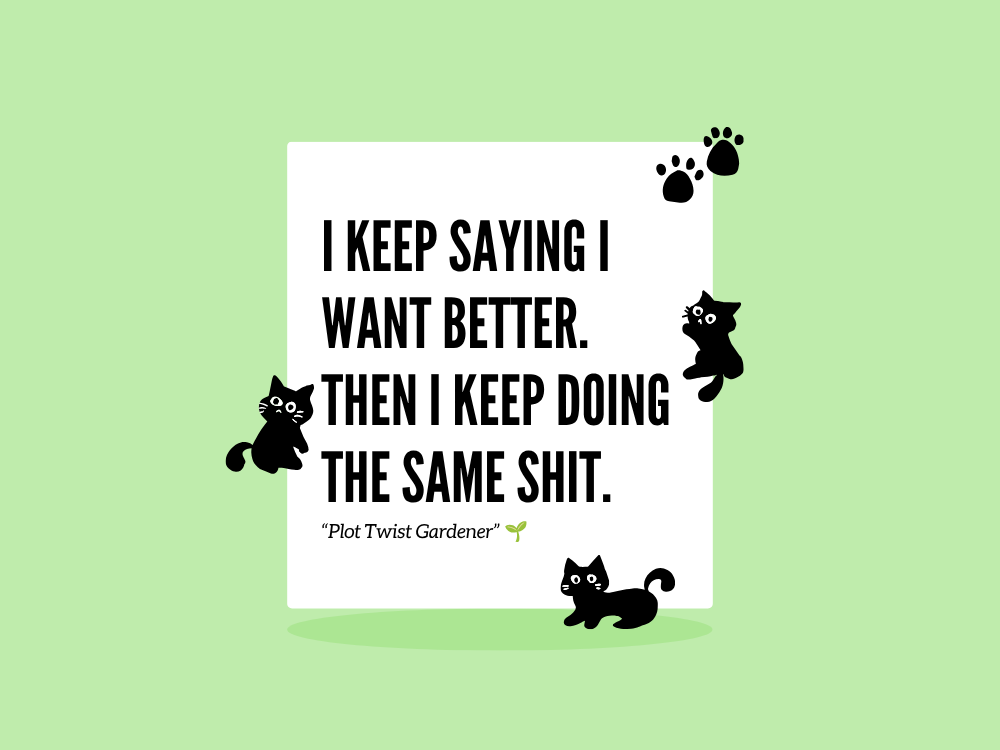
You keep saying you want better.
Then you keep doing the same shit.
Maybe you’re not broken.
Maybe you’re human.
Maybe your current habits are giving you something you haven’t learned how to replace.
Maybe you’re trying to change too much at once.
Maybe you’re waiting for motivation.
Maybe your environment is working against you.
Maybe you’re afraid.
Or maybe you’ve simply spent too much time wanting a different life and not enough time practicing the behaviors that create one.
The good news?
You don’t have to fix everything today.
You don’t have to become a completely different person.
You don’t need a dramatic transformation.
You need one honest decision.
What is one thing you keep saying you want that your daily behavior doesn’t currently support?
That’s your starting point.
Don’t make a giant promise.
Make a small one.
Then keep it.
Tomorrow, make another.
Eventually, something strange happens.
The person who used to say:
“I really need to change.”
becomes the person who says:
“Look at me. I’m actually doing it.”
And that’s when things begin to shift.
Not because you suddenly became motivated.
Not because life magically became easier.
But because you finally stopped waiting for a better version of yourself to show up…
and started building that person with the choices you make today.
You don’t need to want better more.
You need to practice better more often.
And yes, it’s going to be uncomfortable.
Do it anyway.