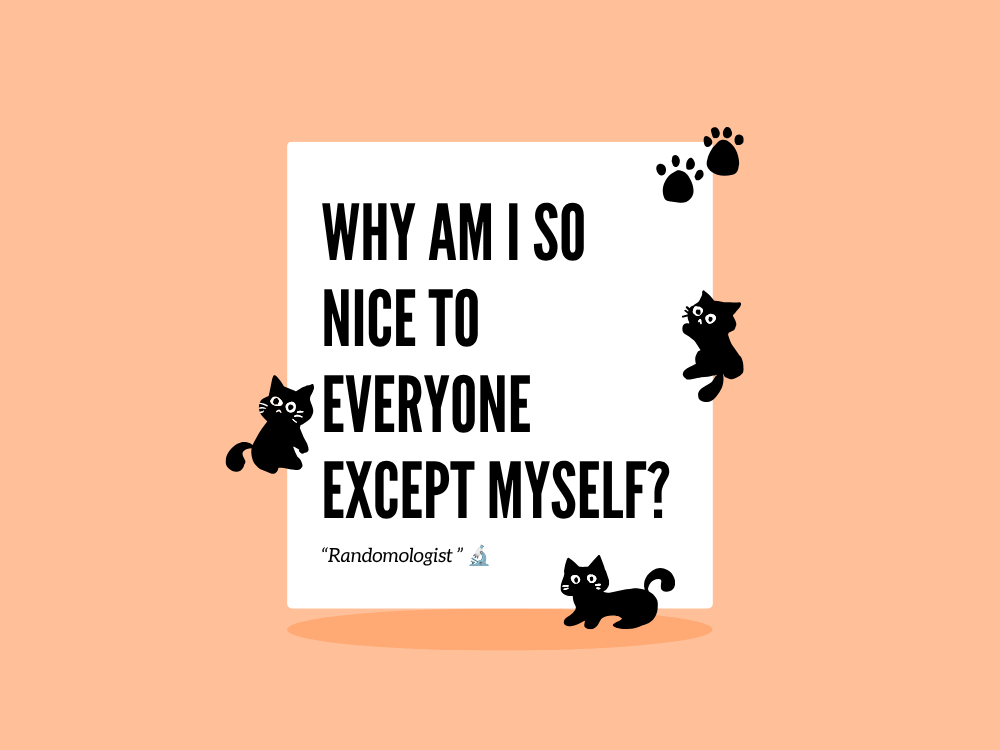
Let’s be honest.
You can be the most understanding person on the planet when it comes to everyone else.
Your friend makes a terrible decision?
“It’s okay. We all make mistakes.”
Your coworker messes something up?
“Don’t worry. It happens.”
Someone you love has a bad day?
“Take your time. I’m here for you.”
But when you make one tiny mistake?
Suddenly, you’re your own personal courtroom judge, prosecutor, and angry jury.
“Seriously? How could you do that?”
“You should’ve known better.”
“Why are you like this?”
“Everyone else seems to have their life together.”
Whoa.
Who gave you permission to talk to yourself like that?
Because if you talked to your best friend the way you talk to yourself, you probably wouldn’t have a best friend anymore.
And yet somehow, we think this is normal.
You’re Everyone’s Therapist, But Who’s Yours?
You know that person everyone calls when something goes wrong?
The relationship expert.
The emotional support human.
The unofficial therapist.
The person who replies, “Tell me what happened,” at 1:37 a.m.
Maybe that’s you.
Someone has a breakup?
You’re there.
Someone has a work problem?
You’re there.
Someone needs advice?
You’re there.
Someone needs help moving?
Guess who’s suddenly a professional moving company?
You.
You somehow have unlimited emotional Wi-Fi for everyone else.
But when your own battery reaches 2%?
“I’ll be fine.”
No, you won’t.
You’re running on emergency power.
And you’ve been ignoring the low-battery warning for approximately six months.
Why Are We So Good at Taking Care of Everyone Else?
Sometimes it’s because we’re genuinely caring people.
That’s a beautiful thing.
But sometimes there’s something hiding underneath it.
We like being needed.
Being helpful makes us feel valuable.
When someone says, “I don’t know what I’d do without you,” it feels good.
It makes us feel important.
So we keep giving.
We answer.
We help.
We adjust.
We forgive.
We say yes.
We cancel our plans.
We put our feelings aside.
And eventually, without realizing it, we start believing:
“If I’m useful, I’ll be loved.”
That’s a dangerous little belief.
Because suddenly, saying no feels like you’re becoming a bad person.
You’re not.
You’re just becoming a person with boundaries.
Your “No” Is Not a Crime
Why does saying no feel like we’re committing a felony?
Someone asks:
“Can you help me with this?”
Your brain:
Absolutely not.
Your mouth:
“Sure!” 😊
And then five minutes later you’re sitting on your bed wondering why you did that.
You knew you didn’t want to.
You knew you didn’t have the energy.
You knew you already had seventeen things to do.
But you said yes anyway.
Why?
Because you were afraid they’d be disappointed.
Here’s the uncomfortable truth:
People are allowed to be disappointed.
Someone being disappointed doesn’t mean you did something wrong.
You can say:
“I can’t today.”
You can say:
“I’m not available.”
You can say:
“I need some time for myself.”
And you know what?
The world will continue spinning.
The sun will rise tomorrow.
Your phone will still work.
Nobody will call the police.
You’re allowed to have limits.
Try This: The 10-Second Rule
The next time someone asks you for something, don’t answer immediately.
Take ten seconds.
That’s it.
Ask yourself:
Do I actually want to do this?
Do I have the energy to do this?
Am I saying yes because I want to—or because I feel guilty saying no?
If the answer is guilt, pause.
You don’t need to automatically say yes.
You can say:
“Let me check and get back to you.”
Congratulations.
You have just discovered the magical land of thinking before agreeing.
It’s beautiful there.
Meanwhile, You Treat Yourself Like a Bad Employee
Think about how you treat yourself at work.
You make one mistake.
You replay it for three business days.
You miss one workout.
“Well, I’ve ruined everything.”
You eat something unhealthy.
“I have no discipline.”
You sleep late.
“I’m so lazy.”
You have an unproductive day.
“I’m wasting my life.”
Meanwhile, your friend does the exact same thing.
You:
“Girl, you were tired. It’s okay.”
Interesting.
Very interesting.
Apparently everyone gets a free lifetime supply of compassion except you.
Maybe it’s time to change that policy.
Talk to Yourself Like You’re Someone You Actually Like
Here’s a fun little experiment.
Imagine your best friend comes to you and says:
“I messed up today.”
What would you say?
Probably:
“It’s okay.”
“Learn from it.”
“You’re doing your best.”
“Tomorrow is another day.”
Now imagine saying those exact words to yourself.
Feels weird, doesn’t it?
That’s how you know you probably need them.
You don’t need to lie to yourself.
You don’t need to say:
“I’m perfect!”
when you know you made a mistake.
Instead, try:
“I messed up, but I’m still learning.”
That’s accountability without cruelty.
There’s a difference.
You Don’t Have to Be Productive 24/7
Somewhere along the way, we started treating rest like a suspicious activity.
You sit down for ten minutes.
“I should be doing something.”
You watch a movie.
“I wasted two hours.”
You sleep in.
“I’m lazy.”
You take a day off.
“I’m falling behind.”
Relax.
You’re a human being.
Not an iPhone.
You don’t need to be at 100% battery all the time.
And unlike your phone, you can’t just plug yourself into a wall and wake up fully charged.
Sometimes your body and brain are asking for rest because they need it.
Rest isn’t a reward for being productive.
Rest is part of being functional.
Stop Comparing Your Behind-the-Scenes to Everyone Else’s Highlight Reel
This one hurts.
You scroll through social media.
Someone got promoted.
Someone got married.
Someone bought a house.
Someone is traveling.
Someone started a business.
Someone is posting their morning routine at 5 a.m. while you’re eating cereal at noon wondering what day it is.
And suddenly:
“I’m so behind.”
But you’re comparing your entire messy life to someone’s carefully selected 12-second highlight.
Of course you’re going to feel behind.
You don’t see their bad days.
You don’t see their arguments.
You don’t see their debt.
You don’t see their anxiety.
You don’t see them sitting on their kitchen floor questioning their life choices.
You see the photo.
That’s it.
So stop using Instagram as a measuring tape for your self-worth.
It’s a terrible measuring tape.
Being Nice Doesn’t Mean Saying Yes to Everything
Let’s clear something up.
Being kind doesn’t mean:
- letting people disrespect you
- answering every message immediately
- fixing everyone’s problems
- lending money you can’t afford to lose
- apologizing when you did nothing wrong
- staying in situations that make you miserable
- ignoring your own needs
That’s not kindness.
That’s self-abandonment wearing a cute little name tag.
Real kindness includes boundaries.
You can say:
“I love you, but I can’t do that.”
You can say:
“I understand how you feel, but I don’t agree.”
You can say:
“I’m happy for you, but I need some time for myself.”
You can care about someone without carrying their entire life on your back.
Start Giving Yourself Small Favors
You don’t need to completely reinvent yourself.
Start ridiculously small.
Drink some water.
Go outside.
Clean your room.
Get enough sleep.
Eat something decent.
Put your phone down.
Take yourself somewhere you enjoy.
Buy yourself the coffee.
Finish something you’ve been avoiding.
Cancel plans when you genuinely need rest.
Say no without writing a three-paragraph apology.
And please stop apologizing for taking up space.
You exist.
You’re allowed to have needs.
You’re allowed to have opinions.
You’re allowed to change your mind.
You’re allowed to take up a little room in this world.
Here’s Your New Rule
Before doing something for someone else, ask:
“Would I tell someone I love to do this?”
If your friend were exhausted, would you tell them to keep pushing?
If your friend were heartbroken, would you tell them to get over it already?
If your friend made a mistake, would you call them stupid?
If your friend needed rest, would you call them lazy?
Probably not.
So why are you doing it to yourself?
You don’t need to become less caring.
You just need to put yourself somewhere on your own list of people worth caring about.
Preferably somewhere near the top.
Not necessarily number one every day.
But at least somewhere on the list.
And No, This Doesn’t Mean Becoming Selfish
This isn’t an invitation to become a villain.
You don’t need to wake up tomorrow and announce:
“I’ve discovered boundaries. Nobody talk to me.”
That’s not the goal.
Keep helping people.
Keep loving people.
Keep being generous.
Keep being the friend who shows up.
Just don’t disappear from your own life while doing it.
Because what good is being there for everyone if you’re constantly abandoning yourself?
You deserve your own support too.
Maybe You’re Not Too Nice
Maybe you’re just forgetting yourself.
Maybe you’ve spent so much time learning how to understand everyone else’s feelings that you forgot yours matter too.
Maybe you’ve become so good at saying:
“It’s okay.”
that you’ve forgotten to ask yourself:
“Are you okay?”
So ask.
Actually ask.
And listen to the answer.
Maybe you’re tired.
Maybe you’re overwhelmed.
Maybe you need help.
Maybe you need a break.
Maybe you need to let go of something.
Maybe you simply need someone to tell you:
“You’re doing okay.”
So here’s your reminder.
You’re allowed to be a work in progress.
You’re allowed to mess up.
You’re allowed to rest.
You’re allowed to say no.
You’re allowed to disappoint people sometimes.
You’re allowed to change.
You’re allowed to take care of yourself without feeling guilty about it.
And you don’t have to become perfect before you deserve kindness.
The Lesson
You spend so much time making sure everyone else feels loved, understood, forgiven, and supported.
Don’t forget one person.
You.
Be the friend to yourself that you are to everyone else.
Because life is already hard enough.
You don’t need to be another person making it harder.
So next time you make a mistake, take a breath before you start attacking yourself.
Next time you’re exhausted, rest before you break.
Next time you want to say no, say it.
And next time that little voice in your head starts saying, “You’re not good enough,” maybe answer back:
“I’m learning. I’m trying. And I’m still worthy of being kind to.”
Honestly?
You probably needed to hear that a long time ago.